




Call now 0208 663 4000
Or "Contact Us" and we'll call you back !


Showing posts with label business. Show all posts

Tuesday, 23 February 2016

In or Out. What do British Businesses Think?

Image Credit: The Guardian

David Cameron is back from his "battle in Brussels" and his reward for his efforts were some considerable reforms on the UK's EU membership agreement including:
  • Child benefit - Child benefit payments to migrant workers to be recalculated.
  • Migrant welfare payments - The UK can decide to limit in-work benefits for EU migrants during their first four years in the UK.
  • Eurozone - Britain can keep the pound while being in Europe, and its business trade with the bloc, without fear of discrimination. Any British money spent on bailing out eurozone nations will be reimbursed.
  • Protection for the City of London - Safeguards for Britain's large financial services industry to prevent eurozone regulations being imposed on it.
  • Sovereignty - The UK will not be part of an "ever closer union" with other EU member states.
  • 'Red card' for national parliaments - It will be easier for governments to band together to block unwanted legislation.
  • Competitiveness - The settlement calls on all EU institutions and member states to "make all efforts to fully implement and strengthen the internal market" and to cut red tape.
  • Some limits on free movement - Denying automatic free movement rights to nationals of a country outside the EU who marry an EU national. There are also new powers to exclude people believed to be a security risk.
But what do UK businesses think about these reforms?

According to the Financial Time bosses more than a third of the companies in the FTSE 100 have declared that Britain is better in the EU and that Brexit would lead to potential job losses and affect investment. Companies including Vodafone, easyJet, BT and Barclays believe an exit from the EU would be negative for the British economy.

Moody's, a key investors service, said: “A decision to leave the EU would be credit negative for the U.K. The economic costs of a decision to leave the EU would outweigh the economic benefits.”

On Monday London Mayor Boris Johnson, a high profile figure, said he'll campaign to quit the EU. Since then the pound dropped to its lowest level in almost 7 years against the dollar, the biggest decline since 2009. 

Are you a business owner? Do you think the UK is better in or out of the EU? Let us know your thoughts. 

360ict provides managed IT services and support for SMEs in central London and the south-east, including Croydon and Bromley. For more advice on gaining competitive advantage as a mid-sized company, give us a call on 0208 663 4000. 

Friday, 20 November 2015

Why India Invests in the UK

Image Credit: Indian Express
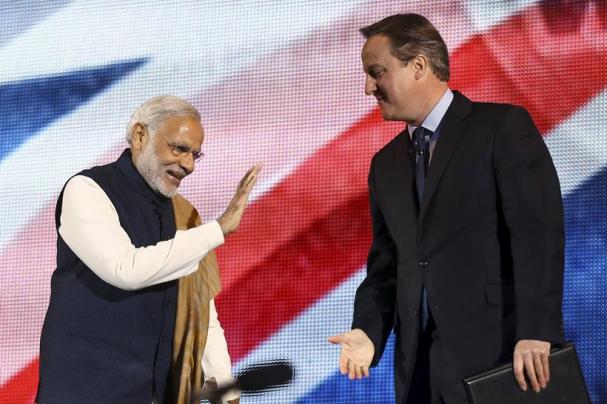
A few weeks ago China’s President made a visit to the UK to discuss the improvement of trade between the two countries, and now India’s Prime Minister, Mr Modi, has met with David Cameron to discuss bilateral deals worth around £10 billion. Is Mr Cameron making a point that the UK would be better off outside of the EU, where these kinds of deals would be much easier to accomplish without all the EU red tape? 

Mr Cameron believes that these are countries with whom Britain should do far more business, but with previous plans, like doubling trade with India between 2010 and 2015, failing, what makes this trip any different?

India is emerging as the strongest economy out of the Bric nations, Brazil, Russia, India and China,  and is growing at 7% per year. 

Earlier this year the UK Trade and Investment (UKTI) released a report confirming that India is now the third-largest source of foreign direct investment into the UK, which increased to 64% in 2014. The UK India Business Council estimated that the total value of Indian investment in the UK totalled at £1.89 billion by the end of 2014s financial year, and 110,000 people are now employed by Indian companies. 

Talking to the BBC, Alpesh Patel of Praefinium Partners, said “that the ease of doing business in the UK, as well as the English language and familiarity with UK institutions, also makes the UK an attractive proposition for Indian investors.” But this works both ways, by 2015 the UK had invested £14.5 billion in India according to CBI, making the UK the largest foreign investor.  


With Mr Modi’s trip dubbed a success, more investment in the UK can only be a good thing. But should UK based companies now look outside of the EU, to countries like India, if they want to grow their business internationally?

Monday, 12 October 2015

Microsoft Unveils Enterprise Class Devices

Image credit: The Next Web

Last week Microsoft unveiled the new Surface tablet and Surface Book, a high-end hybrid laptop, aimed at being the only devices professionals need at work and home. 

Microsoft says that both devices have enough battery life to last the working day, are thin and light with high specs and a sleek finish. Microsoft also boasts that the new Surface devices are up to 50% faster than the MacBook Air and Pro.

We like many of the new improvements including a screen that has very precise detection of touch with pen input. The Surface Book is a powerful machine with an Intel Core i7 processor, Nvidia GeForce graphics card and the screen can be detached so it can used as a tablet or flipped so it sits on top of the keyboard.

The Surface Pro 4 will be the first to run Windows 10, which will include Windows Hello and MDM support. According to Principal analyst from Ovum, Richard Edwards, these additions should appeals to enterprises’ need to simplify management and security.

With flexi working slowly becoming the norm, Microsoft is hoping that these machines will appeal to professionals who want to use a device in and outside the office. 

Edwards says Microsoft is looking to "displace the MacBook Air, which it sees as the target device favoured by the young and trendy people who like to be super mobile but still want that laptop experience".

Gartner research director Roberta Cozza highlights that capturing this market is essential if the Surface is to gain popularity within business. Enterprises are starting to listen to their staff on what devices to purchase, especially when they’re to be used at home as well and in the office. 


"They are building a portfolio that many professional users will like," she said.

360ict provides managed IT services and support for SMEs in central London and the south-east, including Croydon and Bromley. For more advice on gaining competitive advantage as a mid-sized company, give us a call on 0208 663 4000 or head to our website.

Tuesday, 22 September 2015

4 Technology Trends All SMEs Should Look Out For

Image Credit: Luxury Report Mag
Today every business uses some form of technology, but some companies are better at tracking and utilising new and upcoming technology that can transform their business for the better. 

These are exciting and fast moving times for SMEs, and businesses that start adopting evolving technology at an early stage will get the most benefits. So we’ve put together a list of key technology trends to watch out for:

1. The cloud

Cloud solutions take away issues around hardware costs and create a flexible, scaleable and cost-effective service by hosting on the internet. It also allows companies to utilise technology driven tools such as mobile, social media and big data. 

Translating your legacy on-premise applications into a cloud environment can be super easy when using an IT managed service provider.

2. NoSQL databases

If you continue down the cloud route you’ll find out about NoSQL databases, which are part of the larger enterprise big data movement. NoSQL is great for the unstructured data you find in mobile and social media, including video and audio. It’s agile, scalable and flexible, like other cloud based solutions, and it complements what relational databases can offer. 

3. Business sensors

Sensors provide a way for companies to learn about their business, employees and customers. The data collected can then be used to improve all areas of the company including sales and productivity.

Pegged among the “Internet of Things” that brings smarter “things” together, sensors and connected devices with analytics, security, data and integration platforms will transform areas of a business.

4. Don’t completely overlook software

There are many reasons why a lot of companies are moving entirely to the cloud, and there’s much hype in the media surrounding this technology, so it’s often easy to overlook advances being made in infrastructure and operations. The entire operating environment—server, storage and network—can now be virtualised and automated. Data centres of the future promise lower complexity and affordability.

Now businesses are looking at hybrid solutions: Look for an IT support company that can provide expert consultation on whether cloud computing services are best suited to your business, and can also implement a hybrid solution with cloud-based elements that work alongside your legacy systems.

360ict provides managed IT services and support for SMEs in central London and the south-east, including Croydon and Bromley. For more advice on gaining competitive advantage as a mid-sized company, give us a call on 0208 663 4000 or head to our website.

Wednesday, 16 September 2015

6 Ways To Keep Your Company's Data Secure

Image via UK Security Jobs
Over the last few years the media has regularly reported on high-profile data breaches, with cheating site Ashley Madison - where the personal details of around 32 million members were leaked - being the latest company in the limelight. The loss of data has had a major impact on big corporations from financial to breach of trust. However, it’s not just the big companies that get targeted, SMEs are too. In the US last year a staggering $3.5 million losses were recorded from an average data breach. 

This week protection specialist Bit9 + Carbon Black released a survey showing that consumers in Britain are increasingly concerned that there are many data breaches companies have yet to discover. The researchers found that high-profiled security breaches have led to increased fear among the public, with 81% of people worrying that cyber criminals might've already stolen their data without anyone noticing. 

But you can put your customers minds at rest by adopting these six practices from 360ict:

- Stay up-to-date with software, data security news and internal reports

Updating all the software you use daily is essential to keeping your business secure. This includes operating systems and anti-virus software. 

- Create and follow suitable security and backup procedures

Security and backup procedures differ for each company, it’s always worth talking to a risk management expert. 

- Monitor security hazards, regulation and compliance

- Track your digital data

It’s important to understand what data is business-critical or sensitive and what isn’t. You must track this data and identify how it’s used and where it’s stored.

- Manage access to onsite data and protect data taken offsite

One of the main security hazards we face at the moment is the Bring Your Own Device (BYOD). Locking down your data on the move has always been important but now companies need to control data on employees devices and accounts as well as on storage platforms. Picking the correct storage platform is also essential, with many companies opting for the cloud.

- Correctly dispose of data, documents, and equipment that stores data

360ict provides managed IT services and support for SMEs in central London and the south-east, including Croydon and Bromley. For more advice on gaining competitive advantage as a mid-sized company, give us a call on 0208 663 4000 or head to our website. 

Wednesday, 9 September 2015

Queen Elizabeth II: One of the UK’s Most Powerful Brands (and Longest Reigning Monarch)

Image from the Royal Household
Queen Elizabeth II may want to keep things low key and “business as usual”, but millions throughout the country are celebrating today as she becomes Britain’s longest reigning monarch. However, Professor Qing Wang from Warwick Business School has found that the Queen is more than a monarch, she is an essential figure for promoting the UK’s products and businesses. 

Professor Wang said: “The Queen and the royal family are the most significant symbols of British heritage and tradition. They inject a sense of continuity and national identity in the globalised and ever-changing world we live in today.

“The Queen and all the history that comes with her, gives British luxury brands an edge and distinctive advantage.”

Global demand for "Made in Britain" labels means UK luxury good firms are set to get a sales boost, as stated in a report from Frontier Economics. By 2019 the value of sales is said to reach around £51.1bn and, according to Wang, Chinese consumers are showing the biggest growing appetite for British luxury goods. 

Professor Wang conducted a survey of Chinese consumers and asked them what they associated with Britain and the “Britishness” they like so much. Her results show that the Queen and the Royal Family were top of the list. 

“Luxury goods are defined as those satisfying hedonic rather than functional needs and our research has found this is an area that Britain enjoys a distinct advantage in,” said Professor Wang.

“The Queen is a significant reason for this, as a very important factor that makes Britain stand out is that it incorporates tradition and innovation seamlessly.

“Put differently, Britain’s advantage lies in the so-called soft power, which is defined as the ability to get what you want through attraction rather than through coercion, and the UK’s royal heritage is a key part of that.

“The extent of its impact is hard to measure and even harder to replicate. As China promotes its own soft power, it has increasingly turned to Britain for inspiration.”

Professor Wang believes that products and services linked to the Queen and the royal family has helped protect them from any slump in the market.

“The continued profit and sale decline of luxury brands are a strong indication that luxury brands are losing their lustre due to over exposure in the global marketplace and outsourcing of production to other countries.

“There is a trickle-down effect of shoppers looking to emulate the luxury lifestyle, but the conspicuous consumption of middle-class consumers is threatening the very essence of luxury being exclusive.

“But the link to the most important British heritage – royalty - reaffirms to consumers the brand’s authenticity and reminds the public of the golden bygone age. Unique and customised product offerings combined with exquisite craftsmanship and the royal association continue to drive sales in emerging markets.”

Specialist brand and business valuation agency, Brand Finance, has put a figure on the monarchy’s value to the UK. The firm found that that the British Monarchy is worth about £57 bn and will make a net contribution to the economy this year of £1.16bn.


360ict provides managed IT services and emergency IT support for SMEs in central London and the south-east, including Bromley and Croydon. For more advice on gaining competitive advantage as a mid-sized company, give us a call on 0208 663 4000 or contact us via our website.

Friday, 4 September 2015

360ict’s Tips For Relocating Your Business


According to a survey conducted by E.ON this year, over the last 5 years small businesses have lost an average of 7.5 working days as a result of moving premises. 

Moving is always a stressful task, whether you’re moving to a new home or moving your company to a new location, however 31% of SME owners and managers in London say that moving premises is the second most stressful task of their job, more than finances (27%) and customer complaints (13%). 

Anthony Ainsworth, business energy director at E.ON says, 'To hear that more than three quarters of SMEs are staying in potentially inappropriate premises because moving is considered just too hard is surprising. The disruptions businesses face are a very real barrier to relocation and possible future growth.'

But it doesn’t have to be that stressful, we regularly helps companies in Central London, Croydon and Bromley to relocate with 100% customer satisfaction: “What seemed like a daunting and expensive task to begin with, actually turned out to be a cost-effective and simple move with 360ict.” - John Edwards, Company Owner.

If you are thinking of moving, it’s worth getting in contact with one of our relocation advisors.

When should you start thinking about relocation?

Is there enough space: Do you have free desks for new recruits? Do you have enough storage space? When clients walk through the door do they see an organised office? If the answer is no, you definitely want to start looking for a bigger space.

How do you decide on location?

If you’re an SME with a small team you don’t want to be too far from other like-minded companies. For example, if you’re an IT Company or a Business IT Support Company in London look for offices in known tech-hub areas like East London, or the more affordable Croydon. 

If you’re thinking about sharing an office space make sure there are companies or individuals that your team can connect with and that there’s a lively atmosphere. You want to be somewhere dynamic so that your members of staff are inspired. 

Make sure you check the facilities too: internet, storage, parking, local facilities, number of desks and so on. 

Consider a consultant

For some companies a workplace consultant can help to ensure that your new office is running efficiently. This could involve allowing your employees to work remotely or encouraging flexible working times, perhaps staff could use their own laptops too.  

Take advantage of tax breaks

This is a really important tip: Keep up to date on tax allowances because they can save you a lot of money. 

Plan ahead

Think about the things that could go wrong ahead of time. For example, is the internet already set up before you arrive? Are the phones working? Do you need these installed? Will members of staff have to work from home for a couple of days? Always plan for the possibility that there could be a few problems. 

360ict provides managed IT services and emergency IT support for SMEs in central London and the south-east, including Bromley and Croydon. For more advice on gaining competitive advantage as a mid-sized company, give us a call on 0208 663 4000 or head to our website.

Monday, 24 August 2015

Which Political Party Offers The Most Support For SMES?

Image Source: Mark Pack
When it comes to the political divide there’s one thing that all entrepreneurs and SMEs can agree on: extra government support is needed. 

The Entrepreneurs Network recently carried out an annual poll of 100 MPs, which shows that Labour and Conservative MPs have very different views on how best to support British entrepreneurs and SMEs.

Growth Business highlighted the key findings from the report:
  • ‘It suggests almost two-thirds (63%) of Labour MPs believe increasing grants and loans for entrepreneurs would be the best way to support them’
  • Among Conservative MPs, ‘a regime of tax cuts, including slashing business rates and corporate tax, is the most popular policy for driving entrepreneurial growth. Almost all (89%) from the ruling party are in favour of this approach’
  • ‘The issue that splits the house more than any other is the potential impact of the UK leaving the EU – or Brexit. More than half (58%) of Conservative MPs believe that this would be a positive move for entrepreneurs – whereas only 1% of Labour MPs feel the same way’
MPs Are Vocal
  • Growth Business quotes the Entrepreneurs Network Director Philip Salter as saying he was encouraged to see that 'MPs are increasingly vocal about supporting Britain’s entrepreneurs’
  • ‘But he added he found MPs respective view on the EU the most enlightening – especially Labour MPs’ strong support for the EU.’
Ill-Informed About Current Programmes

Growth Business says both sides seem equally poorly informed about current support structures
  • ‘More than one-third of Conservative MPs (38%) have not heard of the Seed Enterprise Investment Scheme (SEIS). And a further 18% don’t feel they know enough’ to comment
  • Labour MPs, despite presenting as broadly supportive of introducing more grants and loans, are ‘also similarly ignorant of current government programmes. More than half (61%) were not aware of Innovate UK – a series of competitions in which £536m of government money is up for grabs’
See the full piece on Growth Business.


360ict provides managed IT services and emergency IT support for SMEs in central London and the south-east, including Bromley and Croydon. For more advice on gaining competitive advantage as a mid-sized company, give us a call on 0208 663 4000 or head to our website.

Monday, 3 August 2015

Calais Crisis Costing UK Businesses Millions

Image source: independent.co.uk
Over the last few weeks drivers have faced huge delays at the Channel tunnel due to the migrant crisis in Calais. So far the UK and French governments haven’t found a solution to the number of migrants now arriving at the port. This has had a huge impact on British businesses as they are being forced to find alternative ways of transporting their goods over the Channel. 

Many companies have had to use aircrafts to transfers essential goods, but even though it is a quick-fix solution, it will cost a lot more money in the long run. 

The Freight Transport Association (FTA) believes the Calais crisis is costing the UK £250m a day in lost trade. The Guardian stated that the study, which was commissioned by Dove economics consultancy Oxera “calculated the annual value of goods in the 2.2m freight vehicles travelling via Dover and Calais to be £89bn, a figure quoted by the FTA as the yearly worth of UK trade.”

What's even more troubling is the fact that the figure could be higher still: Dover claims freight traffic has expanded "considerably" since the study and that it only takes into account ferries, which represent 63% of Channel crossings. The real figure could be as much as £160bn, which would equate to £440m a day in lost trade.

The owner of Lincolnshire-based Denby Transport told ITV News his own company has lost "tens of thousands" of pounds and Welsh haulage firm MCL Logistics told the BBC that it is facing a bill of £100,000 a month. Rolls-Royce, the British carmaker, spoke to The Financial Times and said that the crisis had caused huge delays to incoming car parts: “We have experienced disruption to our production. It’s a challenge, it’s disruptive and we’d rather it wasn’t happening.”

The costs calculated don’t even take in to the consideration the strain on public services. The BBC says Operation Stack has so far cost Kent Police around £700,000, while the Government has said it will spend up to £7m improving security around the tunnel to deal with migrants attempting to illegally enter the UK.

The government is also deciding whether more ferry capacity can be added to different crossing in the UK, including Hull, Portsmouth and Plymouth. However the FTA said the governments needs to come up with long term solutions: “It is an additional cost for hauliers to drive to other ports. If the truck drives another 40 or 50 miles then that adds to costs.”


360ict provides managed IT services and emergency IT support for SMEs in central London and the south-east, including Bromley and Croydon. For more advice on gaining competitive advantage as a mid-sized company, give us a call on 0208 663 4000 or head to our website.

Monday, 22 June 2015

Small Businesses In The UK Grow At Fastest Pace In Five Years

Britain’s small businesses grew solidly over the last three months, according to the latest small business index from the Federation of Small Business (FSB). The strong improvement in small business confidence suggests the sector will continue to grow this year. 

In the study, published on 22 June 2015, the FSB found that 65.3% of small businesses surveyed are striving to increase their business remotely or rapidly between June and September 2015. This is excellent news for London IT support companies. 

The lobby group’s small business index suggested that there has been a “robust” improvement in confidence, which pushed up productivity, job creation and investment at a faster rate than in the economy as a whole. 

It said growth and investment intentions had reached new highs since it began compiling its index in 2010.

It also said it had found a “few negatives” in the overall picture. The gains were to spread evenly over the UK, however — by far the highest concentration of growing small business were found in the South East of England, followed by the Midlands. In Wales confidence and employment fell, and Scotland also reported lower business confidence. 

John Allan, the FSB national chairman, said: "The results... are very positive and show the major role that small businesses play in the growth of the UK's economy. It is critical the new government continues to develop the right environment to support businesses planning to grow, invest and take on new staff in the next 12 months. In the Budget and its upcoming Enterprise Bill, ministers should prioritise supporting small business growth, simplify business taxes, raise skills and tackle poor payment practices.”

The UK government is working on an Enterprise Bill, which it hopes will make the UK a leading place to set up and expand small businesses, including IT support companies in London, and should create two million jobs between 2015 and 2020. This is just one of many initiatives that the government are planning to implement for businesses in the next five years. 

360ict provides managed IT services and emergency IT support for SMEs in central London and the south-east, including Bromley and Croydon. For more advice on gaining competitive advantage as a mid-sized company, give us a call on 0208 663 4000 or head to our website.


Wednesday, 27 May 2015

UK Inflation Turns Negative For The First Time Since 1960

Figures released recently have revealed that the main measure of UK inflation turned negative for the first time since the measure has been in existence. 

The measure, known as the Consumer Price Index (CPI), reached a figure of -0.1% in April and based on historical estimates, is the first negative figure that has been recorded in the UK since 1960. It is believed that the biggest contribution to the downturn of inflation came from a fall in travel fares, with costs thought to be 2.8% lower than last year. Food is also 3% cheaper compared to April 2014s figures. 

Mark Carney, governor of the Bank of England, discussed his thoughts on whether this statistic represented an ongoing trend in the UK economy. Although he did think that the situation would remain largely similar for the next few months he did think that ‘towards the end [of the year], inflation should start to pick up towards our 2% target.’ 

In the interview below, Chancellor George Osborne stated that these figures should not be mistaken for ‘damaging deflation.’ Forecasters believe that the negative inflation will not last long and are avoiding describing these figures as a sign of deflation. George Osborne did add that ‘of course, we have to remain vigilant to deflationary risks and our system is well equipped to deal with them, should they arise.’

As a result of these comments, business owners and others are left wondering whether their own companies are equipped to cope with wider economical changes. In light of the figures released it is crucial companies arrange their businesses in a way that will safeguard their operations. 

To find out more about safeguarding your business and emergency IT support or if you have any questions please get in touch with us. 


360ict provides managed IT services and support for SMEs in central London and the south-east, including London Victoria, Euston, Croydon and Bromley. For more advice on gaining competitive advantage as a mid-sized company, give us a call on 0208 663 4000 or head to our website.

Friday, 22 May 2015

UK SMEs Have Their Say About The Country's EU Membership

This week a survey was released by Bibby Financial Services, which shows that UK SMEs want the new Government to provide simplicity and stability.

The survey highlights EU membership as a key concern for small businesses over the next few years and that almost a quarter want a simplified PAYE system. A reduction in business tax rates and an end of late payments by large companies were also high among concerns. And like many in the business community we are all left wondering what an exit from the EU might mean for staffing, exports and tariffs.

The survey highlighted many problems that SMEs face including the red tape that comes with being part of the EU. Talking to The Guardian Paul Statham, director of software development business Condeco, says he is pro-Europe but “there is a burden and I know that that is something which the government is continually battling with and I think they should continue to fight with the British point of view.”

Andy Bagnall, director of campaigns at the Confederation of British Industry also pointed out to The Guardian [that] “it is vital that the EU does more to support small businesses, like scaling back unnecessary regulation that can often burden smaller businesses, and making it easier to sell online across Europe.”

Business for Britain has stated that EU regulations accounted for 60% of all EU law, which led its chief executive Matthew Elliott to say that the Commission and the European Parliament see regulation as the answer “to every problem the EU faces”.

However, there is a feeling of indifference towards the EU from companies who don’t export. The IoD’s head of Europe and trade policy Alexandra Renison says: “For many of these businesses, they see all of the regulation with comparatively little in terms of concrete benefits that they're exporting counterparts do. Keeping in mind that over 99% of private sector businesses in the UK are SMEs (according to the government’s own estimate) and that only one in five UK SMEs export, that apathy may be more widely shared than many in internationally-oriented (both politically and economically) London may realise.”

From a business point of view would you rather see the UK in the EU? Let us know your thoughts!

360ict provides managed IT services and support for SMEs in central London and the south-east. For more advice on gaining competitive advantage as a mid-sized company, give us a call on 0208 663 4000 or contact us via our website.

Thursday, 30 April 2015

End Of The Road for Windows Server 2003

Time has nearly run out for Windows Server 2003, in a few short months Microsoft is going to stop support. This means that the stream of security updates and bug fixes customers have received over the last 12 years will cease. 

People may wonder what all the fuss is about: Windows Server 2003 has been around for 12 years, surely it’s time for an update, right? However, businesses typically don’t replace critical servers and infrastructure often, definitely not in the same way consumers upgrade to the latest Apple products. 

Microsoft will pull support on July 14, and over the last week businesses have been discussing the effect impending support suspension will have on SMEs who haven’t upgraded their servers. Over the next few weeks these businesses will have some major decisions to make about the future of their server environments, and we're here to help with this awkward transition.  

A recent survey from Spiceworks revealed that companies across the US are allocating $60,000 for migration-related expenses on average, and that many of these migrations have already begun. For SMEs in the UK, if you haven’t started migrating to new servers, now is definitely the time to do so, because after July 14 2015 holdouts face a risky future. 

When it comes to security, Windows Server 2003 is certainly no Fort Knox, but continuing to use it post July 14 could have some serious security repercussions. 

Ade Foxall, CEO of application portfolio management firm Camwood, believes that “after the recent migration away from Windows XP, IT departments should be more aware than ever of the dangers of using an out-of-date platform. And yet, the lack of awareness surrounding Server 2003 is about to pose an unprecedented security threat to businesses all over the world.”

There is an upside to moving away from Windows Server 2003: businesses have the opportunity to modernise their environments, like moving to the cloud. In another survey conducted by Spiceworks, they found that 64% of business planned to migrate to Windows Server 2012 while the remainder would take their applications into the virtual space.

This is a critical time for SMEs and it’s important that the right decisions are made. Here at 360ict we can help businesses move away from Windows Server 2003 in a simple and affordable manner. If you have any questions, please get in touch!  

360ict provides managed IT services and support for SMEs in central London and the south-east, including London Victoria, Euston, Bromley and Croydon. For more advice on gaining competitive advantage as a mid-sized company, give us a call on 0208 663 4000 or head to our website.


Friday, 17 April 2015

Why SMEs Are Choosing 360ict For Their IT Managed Services

Why Choose Us?

360ict has been a full managed services provider in London for over 10 years. We help small and midsize enterprises achieve the results that matter most with our technology expertise and flexible ICT solutions. 

We believe in:

No contracts. 
We believe in earning your business so there’s nothing keeping you as a client from staying with us other than you knowing we’re the best Business IT Support Company out there. To date, all of our clients have given 100% positive feedback. 

Keeping it simple. 
We provide essential office support, from basics such as business internet to cloud and data centres, relocation services and printer fleets. We want to be the one phone number you call when problems come up.

Transparency. 
No hidden fees, no hidden advice, we give you what we promise the first time.

Reasons to work with us:

- We offer a simple to use, commitment free (no email address / portal login) calculator to help you review the value of your ICT service provision.

- We guarantee 100% absolute satisfaction. No contracts make sure we have to be on top of our game.

- We’ve been around for a while! We’ve found the right formula for servicing ICT.

- Get all your ICT services under one roof, no more dropped lines of communication between two third parties. We do it all and you get one number to call for anything ICT related.

- We’ll have a technician working on your issue in 60 minutes or less. Our location (Central London, Victoria, Euston, Bromley and Croydon) lets us respond, fast.

- We’re one of the first IT service providers in London to offer “green hosting” which uses low-cost power and natural weather resources so your business can be proud of its environmental ethics.

- We make sure your office is secure. Remote backups, firewalls and network monitoring means that you can have piece of mind that nothing will get lost or stolen.

- None of our services are pre-determined. We tweak and cater our services towards your offices’ specific needs. Get exactly what you need and want.

- You’ll have a fully supported infrastructure leaving you free to concentrate on your customers.

360ict provides managed IT services and support for SMEs in central London and the south-east, including London Victoria, Euston, Croydon and Bromley. For more advice on gaining competitive advantage as a mid-sized company, give us a call on 0208 663 4000 or head to our website. 


Wednesday, 8 April 2015

Windows XP Still Going Strong

Despite being 13 years old, Windows XP is still one of the most popular operating systems according to Net Application’s Web stats, which gave XP a 16.9 share for the month of March. Even though it’s still the second most-used operating system, the number of people using XP has significantly dropped. Though XP’s grip on the market is loosening, it still beats Windows 8 and 8.1 collective share of 14 percent. Windows 7 holds the top spot, with a share of 58 percent. 

Microsoft ended support for XP over a year ago, which put an end to bug fixes, however users are still reluctant to upgrade, even though they are more vulnerable to security threats. 

This has had a ripple effect for other companies, for example, chipmaker Intel slashed nearly $1 billion of it’s quavery revenue outlook. This is mainly because small and midsize businesses have been reluctant to upgrade from XP. 


For those determined not to upgrade to Windows 8 or 8.1 the next release comes this summer when Windows 10 will become available. If SMBs want to upgrade from XP to Windows 10, it won’t be an easy process. You won’t be able to upgrade your PCs directly to Windows 10, you’ll have to upgrade to Windows 8.1 first, or buy new PCs already equipped with Windows 10 this summer: not the cheapest of options!

Are you a Windows XP user? Will you be sticking with XP or biting the bullet and upgrading to 8.1 to access 10? Let us know your thoughts! If you need help deciding, we're supporting companies in London Euston, Victoria, Croydon and Bromley throughout the year with their transition to Windows 10 - get in touch for more information. 

360ict provides managed IT services and support for SMEs in central London and the south-east, including London Victoria, Euston, Croydon and Bromley. For more advice on gaining competitive advantage as a mid-sized company, give us a call on 0208 663 4000 or head to our website. 

Friday, 20 March 2015

Skype for Business Heralds New Era For Communication


This week Microsoft launched a preview of Skype for Business with a clear message: this is just the beginning. Microsoft is preparing for the future of “smart living” with the idea that Skype will be available on any device, anywhere, and users will be able to share date, translate calls and have two-way annotated meetings.

Skype for Business will unify Lync and Skype: according to Microsoft “over 100 million people now use Microsoft Lync to communicate for work, with 79 percent of U.S. enterprises currently using or planning to deploy Lync for telephony.” Combine that with Skype’s 50 billion minutes of traffic every month, and Skype for Business will surely become the preferred choice for business-to-business and business-to-consumer communications. 

Through this collaboration users will be able to place calls and start conferences over old school landline connections with a traditional phone number. This is great news; previously this functionality would require businesses to have a Lync Server set-up and pay a separate PTSN service from a third-party. Microsoft is now working with Vodafone (and other companies) to make the transitions between VoIP and landline calls easier in Office 365. 

Lync Room Systems is also getting an update to become Skype Room Systems, an initiative to supplement physical meeting spaces with Skype technology. Skype for Business will integrate all of Lync’s features into a Skype-style interface, which will allow Lync users to connect to anyone using a Skype user name. All of the productivity-boosting communication tools will still be available and enhanced. 

If your business isn’t using Office 365 currently, now is the time to start thinking about incorporating it into your company. Earlier this week Microsoft unveiled the technical preview of the Skype for Business client, which gives customers an opportunity to trial Skype for Business and begin preparing for deployment. If you have any questions about Office 365, or are interested in Skype for Business (the new service will begin rolling out next month), get in touch today for more information about how we can help you improve your business communication services with Office 365.  

360ict provides managed IT services and support for SMEs in central London and the south-east, including London Victoria, Euston, Croydon and Bromley. For more advice on gaining competitive advantage as a mid-sized company, give us a call on 0208 663 4000 or head to our website. 

Sunday, 15 March 2015

Will 5G Revolutionize Your Business In 2020?

One of the main highlights at this year’s Mobile Congress World in Barcelona was 5G. 5G is the next development in mobile technology, but will 5G improve the way businesses are run or is it all just hype?

Commercial 5G is expected to arrive around 2020, with full deployment towards the middle of that decade. But what can businesses actually expect from 5G, will it really be worth making the switch from 4G?
  • It’s going to be ridiculously fast: we’re talking downloading an entire film in a second or video calling a client without any of the time delays or glitches.
  • Smarter technology: devices will have to become smarter in order to successfully run 5G. But we’re talking more than just smartphones and laptops, this includes everything from printers to washing machines. 
  • Increase in capacity: businesses will be able to connect all electronics to 5G, making the management of offices that much simpler. 
  • It won’t break: a network that “won’t break”? Improving reliability issues is one of the main pros of 5G. 
There are many significant issues that telco providers are currently addressing: one of the main issues according to Business Spectator is that “the success of 5G will have more to do with connected systems than the 5G technology as such. 5G will involve a range of industry sectors and can only be successful if the applications are built in partnership and in collaboration with those sectors.” This means that new business models will have to be introduced. 

One thing is certain. The capabilities of 5G will add a whole new dimension to what the mobile industry is all about, and how businesses will have to adapt to be able to run and use this new technology.

360ict provides managed IT services and support for SMEs in central London and the south-east, including London Victoria, Euston, Croydon and Bromley. For more advice on gaining competitive advantage as a mid-sized company, give us a call on 0208 663 4000 or head to our website.